Coursework Overview
My coursework in the MA Human Rights and Social Justice program reflects my journey of learning, reflection, and transformation. Each course I’ve taken has helped me connect academic theory with real-world experiences, deepening my understanding of human rights, decolonization, and community care. These classes have not only strengthened my critical thinking but also inspired me to express my ideas creatively and compassionately through writing, art, and lived engagement.
Courses Taken – Fall 2024
During my first semester in the Master of Arts in Human Rights and Social Justice program at Thompson Rivers University, I completed three foundational courses that shaped my understanding of human rights, Indigenous knowledge, and community empowerment through creative and relational approaches.
Courses Completed:
HRSJ 5010 – Foundations of Human Rights and Social Justice
HRSJ 5020 – Indigenous Ways of Knowing: Resurgence of Land-Based Pedagogies and Practices
HRSJ 5710 – Food, Art, and Community Empowerment
Each of these courses helped me connect theory with lived experiences. Foundations of Human Rights and Social Justice introduced me to key frameworks such as decolonization, intersectionality, and critical race theory, giving me a strong grounding in how structural inequalities shape people’s lives. Indigenous Ways of Knowing encouraged me to see the land as a teacher and deepened my respect for Indigenous sovereignty, cultural resurgence, and relational ethics. Food, Art, and Community Empowerment offered a creative and experiential approach to understanding food as both a life force and a site of resistance against capitalist and colonial systems.
In HRSJ 5710, one of the most meaningful parts of the course was writing weekly reflections based on Vandana Shiva’s readings, which allowed me to connect global ideas of food justice with my own lived experiences from Kerala, India. One week, I wrote a short poem based on a real incident of farmer suicide an issue that has deeply affected families in my community and this creative expression helped me face the emotional reality behind the statistics I often read. My final research paper also focused on farmer suicides in India, allowing me to explore how debt, industrial agriculture, and policy failures intersect to create long-term suffering for farming communities. In these reflections, I also brought in my own pothichoru mission, a Kerala practice of sharing meals wrapped in banana leaves with those in need. Including pothichoru helped me connect Vandana Shiva’s ideas of ecological wisdom and food sovereignty to the everyday acts of care, dignity, and resistance I grew up witnessing. Together, these academic and personal experiences shaped my understanding of food justice as not only a political issue but also a cultural and emotional commitment rooted in memory, community, and responsibility.
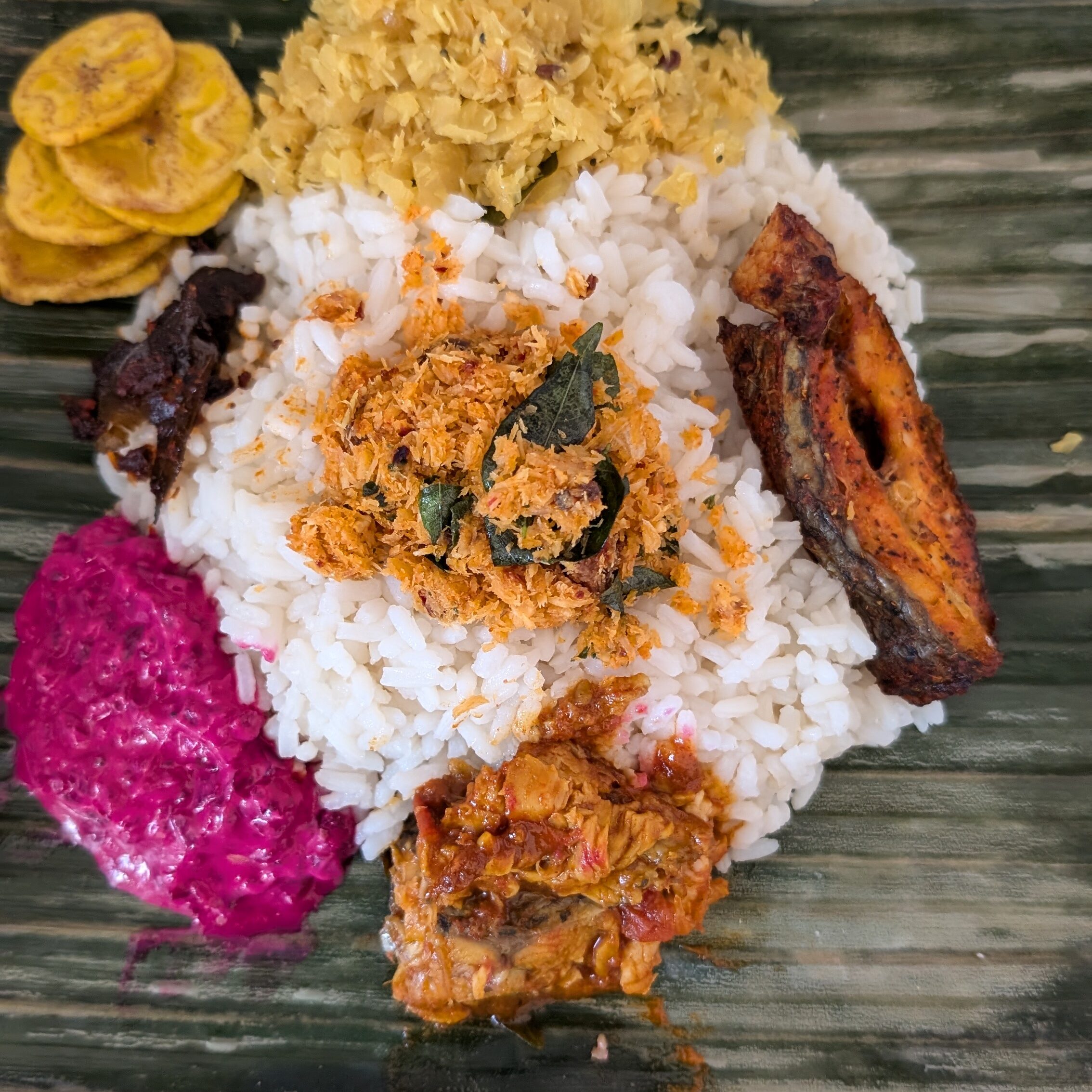
An image of pothichoru
This first semester was transformative for me, as it allowed me to link my cultural background, personal values, and professional goals to a deeper global conversation on justice, decolonization, and the right to live in harmony with one another and the land.
Courses Taken – Winter 2025
In my second semester of the Master of Arts in Human Rights and Social Justice program at Thompson Rivers University, I continued to deepen my understanding of research, decolonization, and global justice through three interdisciplinary courses that challenged my thinking and expanded my methodological, ethical, and analytical perspectives.
Courses Completed:
HRSJ 5030 – Problem Solving in the Field: Study Techniques and Methods
HRSJ 5120 – Settler Colonialism: Decolonization and Responsibility
HRSJ 5260 – Contemporary Capitalism
Problem Solving in the Field introduced me to a wide range of research methodologies used in the social sciences and humanities, from quantitative to qualitative approaches. I learned how to formulate research questions, design proposals, and consider ethical dimensions in data collection and analysis. The emphasis on Indigenous and anti-colonial approaches to research, particularly those practiced in the Global South, encouraged me to think about research as a relational and respectful process that centers community voices rather than imposing external frameworks.
Settler Colonialism: Decolonization and Responsibility was an eye-opening course that helped me understand settler colonialism not as a past event but as an ongoing system of power and dispossession. Through class discussions and readings, I reflected on how colonial structures continue to shape societies like Canada and India, and how personal responsibility and decolonial practice can contribute to justice and reconciliation. This course deepened my awareness of land, identity, and belonging, urging me to examine my own position within colonial histories.
In Contemporary Capitalism, I explored the global dynamics of capitalism and its connection to extraction, production, consumption, and waste. Drawing on interdisciplinary perspectives, the course allowed me to critically analyze how economic systems influence human relationships and environmental sustainability. I was especially drawn to discussions on moral economies and the resistance movements that challenge capitalist exploitation through labor, environmental, and gender justice. These themes connected closely to my own interest in food justice, care work, and ecological balance.
This semester strengthened my ability to connect theory with practice, ethics with research, and local experiences with global systems of power. It helped me see how knowledge creation itself can be a decolonial act one rooted in care, responsibility, and the continuous pursuit of justice for both people and the planet.
Courses Taken – Fall 2025
In my third semester of the Master of Arts in Human Rights and Social Justice program at Thompson Rivers University, I engaged with courses that deepened my understanding of social justice, historical memory, and activism. These interdisciplinary courses challenged me to think critically about systemic violence, representation, and the ways art and media can be used to resist oppression and amplify marginalized voices.
Courses Completed:
HRSJ 5110 – Genocide in the 20th Century
This course offered an interdisciplinary examination of genocide through historical, philosophical, and literary perspectives. I explored case studies from across the twentieth century to understand the social, political, and ethical dimensions of mass violence. Topics such as eugenics, colonialism, and the role of language in constructing and justifying oppression deepened my awareness of the complexity of genocidal processes. The course encouraged me to critically reflect on ethical responsibility, memory, and representation, and helped me develop skills to contribute thoughtfully to the study of genocide.
HRSJ 5140 – Art, Media, and Dissent: Bridging the Local and the Global from the Guerilla Girls to the #MeToo Movement
This course examined how feminist social movements use art and media to challenge systemic inequalities and mobilize communities. Through case studies including the Guerilla Girls and the #MeToo movement, I analyzed the strategies and impacts of visual art, digital media, and public performance in advocating for gender justice. The course encouraged reflection on issues such as bodily autonomy, sexual violence, environmental justice, and access to public and digital spaces. By connecting theory to creative practices, I gained insight into how activism, media, and artistic expression intersect to foster global solidarity and amplify marginalized voices.
This semester strengthened my ability to connect historical and contemporary struggles for justice with ethical reflection and creative engagement. It highlighted the importance of interdisciplinary approaches in understanding complex social issues and reinforced my commitment to advancing human rights, social justice, and equitable representation through both critical scholarship and community-centered practice.