The course of Human Rights and Social Justice program that I have undertaken at TRU has been an academic and personal experience that has changed me. Having a personal background of being an Indian studying in Canada, I have learned to realize that human rights and social justice are not only about the legal and theoretical notions but actual realities, deeply rooted in culture, history, power relations, and inequalities. Every course that I have taken provided me with the chance to be critical, apply theory into practice, and hear a wide range of opinions that have broadened my perception of justice in multiple ways.
The most important frameworks that I discussed in Foundations of Human Rights and Social Justice (HRSJ 5010) were intersectionality, Indigenous rights, and feminist views. These ideas made me aware of how social structures and histories act to influence the experience of oppression and resiliency of people. Discussions and group work in the classroom have really forced me to think about my own positionality as an outsider of Indian origin and the advantages and restrictions that follow that. To illustrate, speaking of colonial histories and its still existing effects, I had been able to relate the themes to the history of my own country and meditate on how systemic inequalities may still affect the social systems and human rights. Writing projects that ended up with these discussions enabled me to clearly express my ideas as I interacted with theory in some manner in which it related to the realities of life.
The best one was Indigenous Ways of Knowing (HRSJ 5020) due to the combination of classroom education and the opportunity of experience. My visit to the Kamloops Residential School and hearing the account of the Elders made me realize how settler colonialism can continue to affect the lives of Indigenous peoples and how resilient Indigenous communities are. My culture-related activities and workshops also made me aware of the language of the Secwepemc, their traditions, and values. These experiences were not mere theory, as I learned how the relationships, respect, and cultural understanding are the foundations of human rights. The course also forced me to reflect on my role as an ally and the significance of being humble and culturally sensitive in the social justice work.
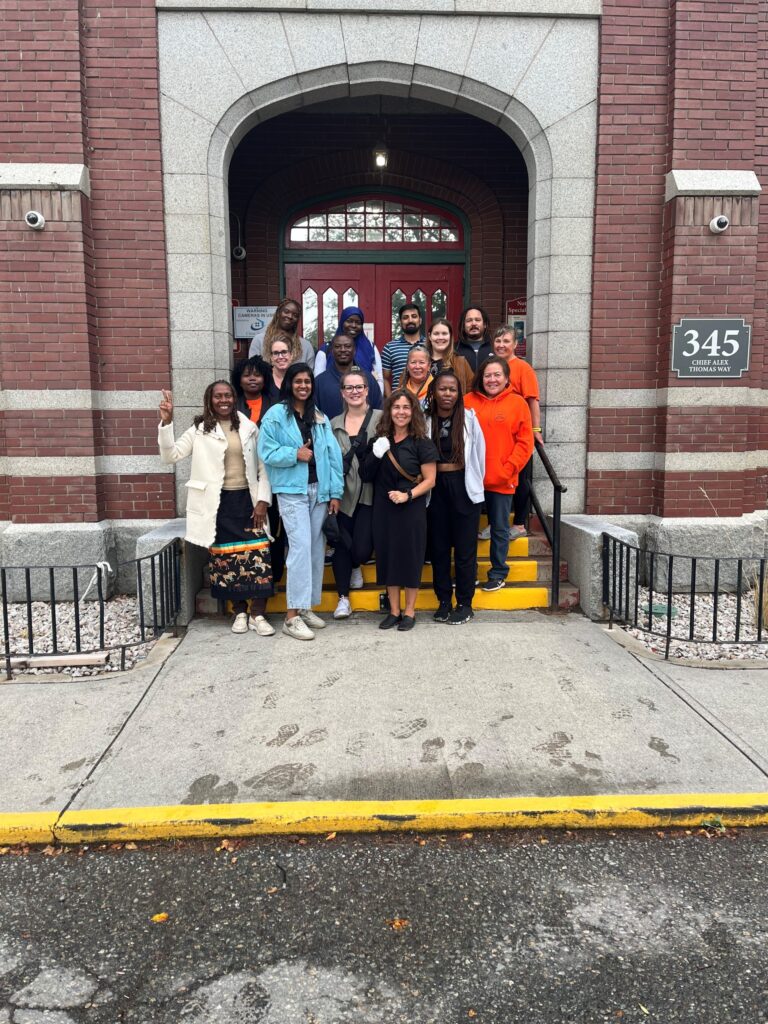
Group photo after visit to Indian Residential School, Kamloops (Provided by :
Jenna Woodrow)
At Food, Art and Community Empowerment (HRSJ 5710), I got to learn the intersection of creativity, community activities and grassroots activism with human rights. The field visits to the urban farms, community kitchens and local art galleries showed me personally how food insecurity, environmental sustainability and social inclusion are interconnected with systemic injustice. My set of settler colonialism art on canvas gave me an opportunity to show respect to Indigenous people and convey the message about the necessity to appreciate culture and histories as a foreigner. These two experiences have demonstrated to me that human rights work is a favorable process that calls to action as well as reflection and that creativity can be an effective method in advocacy and raising awareness.
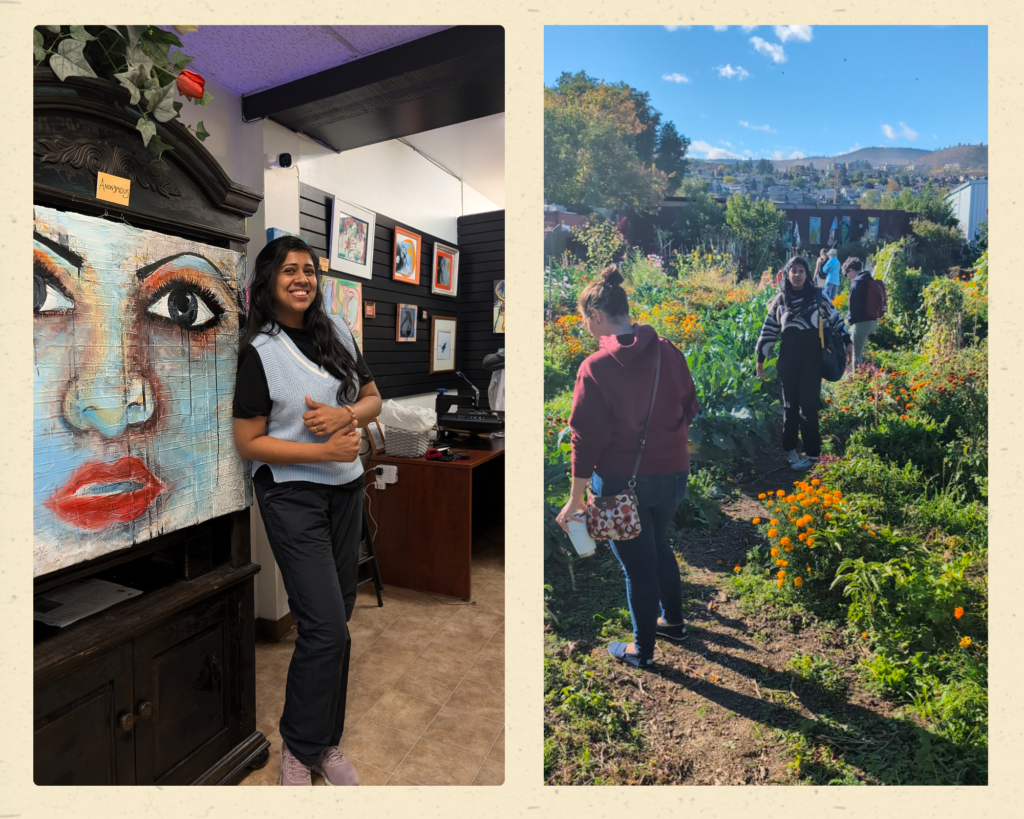
Image captured during my visit to the Same Sky Collective Art Gallery and the community garden in Kamloops.
These courses have helped me to understand that human rights are not merely theoretical postulates but are practiced, communal and relational in communities. Every assignment, discussion, and experience activity allowed me to relate what I learned in the classroom with real-life problems and improved my skills to think critically, act ethically and be open-minded to other viewpoints. In general, my coursework has helped me to understand human rights as very interwoven with culture, history, and community and enjoy further promoting equity, justice, and transformative social change.