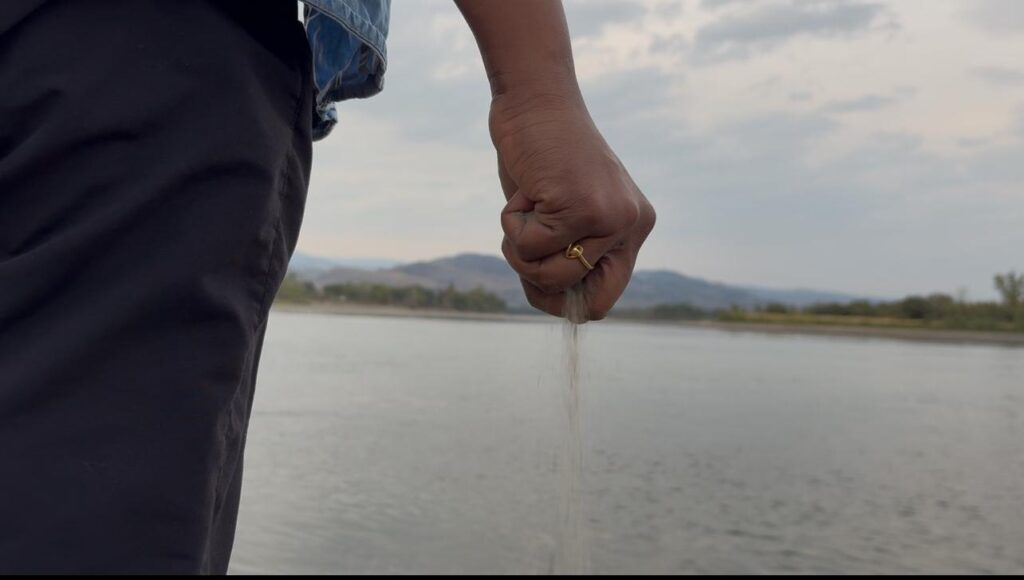
Photo of author taken at Riverside (2025)
When I entered this this program, I believed that my understanding of social justice was very shallow as I considered people to be ill-treated, and the system must be reformed so everyone could live with dignity. However, as the months passed, each course helped me grow in knowledge in some aspects that were unpleasant, upsetting, and quite personal. I gradually learned that social justice is not merely a concept that we learn; it is a fact that we experience, bargain, and bear with us as we pass through the world.
The earliest experience when this broke through my mind was in my course HRSJ 5710- Food, Art, and Community Empowerment when I decided to investigate the suicides of farmers in India. This subject was very personal to me since it is not an abstract case study, but a sore that many families, communities and even people I have known are still lamenting about today. It created a new understanding of the burden of structural violence in me after studying it academically. I always heard about these tragedies in discussions, in the press, or on the Internet, but when I did a deep research, I began to see the whole line of exploitations: seed monopolies, debt, climate pressures, institutional support, and the intersection of caste and gender in them. The question was not, as it suddenly increased, why a farmer was made to suffer but why a whole system had been constructed to ruin the farmer. That change of mindset has remained with me, and I believe it influenced my way of thinking about the subject of responsibility, my own, the one of my country, and that of the global food system.
The same occurred once more in Art, Media, and Dissent, when I made a video reflection after viewing a video Kanehsatake: 270 Years of Resistance. Being an Indian outsider on the Indigenous land, studying and working, I felt guilty and humbled myself in the course of interacting with this story. The movie not only demonstrated to me the injustice committed against the Mohawk people, but also, the great power of endurance that land, culture and collective memory give. As I had been observing the barricades, the anger, the sorrow, and the unswerving resistance, I could not but compare it to the history of the colonialism in my own state, Kerala, and the struggles of the Indigenous people there. The reflection made me look at my personal position: I am lucky to be living in Canada, and I am also standing on the land that has been formed by continuous colonial constructs. The understanding of that was an essential element of my educational experience, not guilt, but responsibility. This is what made me want to paint my canvas about settler colonialism and attempt to honor it as a person, who is a descendant of another colonized nation today, yet resides on the Indigenous land.
However, in the course of the coursework, I started realizing the interconnectedness of it all. It seemed that the stories of farmers in India and the stories of Indigenous resistance in Canada had little in common, however, the more I read them, the more they showed the same patterns loss of land, loss of autonomy, manipulation of resources, and systems that think they are helping but only cause more harm. This has been my realization as I realized that social justice cannot be acquired based on theory only. Every reading, film and creative project challenged me to question the way I am involved in systems without being conscious of it. It also caused me to think about the food that I purchase, the land that I inhabit, and the pasts that I am enjoying.
The other source of learning I consider significant was through discussions with classmates. Whenever we exchanged our opinions, I was able to sense the difference in our initial positions, but how we were very similar in our emotional response when we talked about injustice. Their backgrounds of immigration, identity, gender, and family also assisted me in growing my own knowledge. I have understood that social justice cannot be seen through just a single lens that is perfect, but through overlaying many lenses until you begin to see a more complete picture. The picture would never be complete even then, as the world is ever changing, so are we.
Another lesson that I gained through this program is that solutions are not straightforward. Previously I have believed that once we have known what is wrong then it should be easy to fix it. However, now I understand the ways in which each problem is related to others ones in terms of poverty, environment, gender, colonialism, mental health, and access to resources. The difficulty with which I was oppressed, but now inspires me. Rather than querying, how can I get all the things sorted? I have learned to enquire, What can I do well, carefully, empathically, responsibly, one thing? These can be minor, yet minor actions have an impact.
I have acquired one fundamental belief through all the courses I have done and that is justice starts with listening. Listening to narratives, to land, to food, to people, and to the silences that conceal structural violence. My homework was not only a schoolwork, it was one of the moments that determined my perception of the world and my role therein. I am now able to see social justice as a lifelong practice, which is embedded in the daily decisions, respectful acts and the boldness to act.